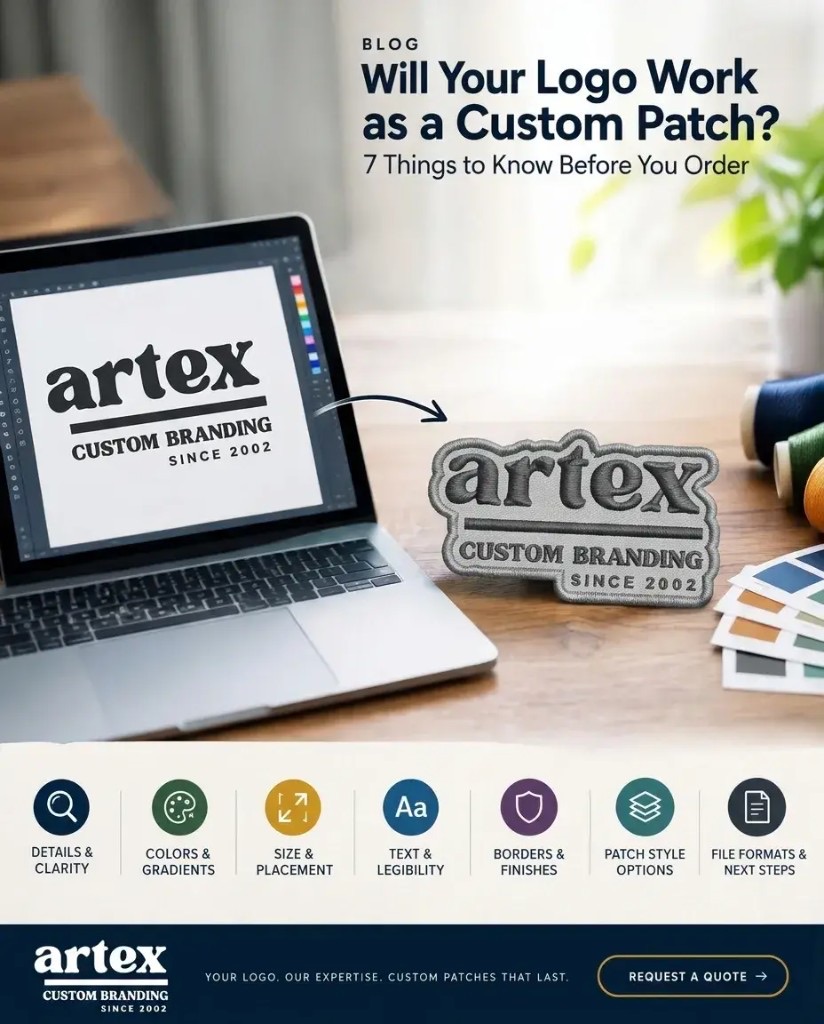
You already have a logo. Maybe it looks great on your website, business cards, uniforms, or social media. But that doesn't necessarily mean the exact same artwork can be used on a custom patch without making a few changes.
One of the most common questions we hear at Artex Group is: “Can you make my logo into a patch?”
In most cases, the answer is yes. The important question is how your logo needs to be adapted for the material, size, and level of detail you want.
Here are seven things to consider before turning your existing logo into a custom patch.
This is one of the biggest factors in determining whether a logo will translate well into a patch.
A logo that looks perfectly clear on a computer screen may contain lettering, thin lines, small shapes, or tiny spaces that are simply too small to reproduce cleanly with thread or other patch materials.
For example, imagine a logo with:
Those details may need to be simplified or enlarged to make the finished patch readable.
The smaller the patch, the more important this becomes.
This doesn't mean your logo has to be redesigned from scratch. Often, our designers can make small adjustments that preserve the overall appearance while making the artwork work better as a physical patch.
Digital artwork gives you almost unlimited freedom. A patch does not always work the same way.
Embroidered patches are created with thread, so gradients, soft shadows, and photographic effects aren't reproduced in exactly the same way they appear on a screen.
If your logo is primarily made up of solid colors and bold shapes, embroidery may be an excellent choice.
If your artwork contains:
a dye-sublimated patch may be a better solution.
Sublimation allows detailed artwork and color transitions to be printed into the patch rather than represented entirely with individual embroidery stitches.
For a design with fine lines or small lettering, a woven patch may also be worth considering because the thinner threads can create a cleaner, more precise appearance.
The goal isn't to force every logo into embroidery. The goal is to choose the construction that makes your particular artwork look its best.
The same logo can work beautifully as a 4-inch patch but become difficult to read as a 2-inch patch.
This is why patch size should be considered along with the artwork—not after the design has already been finalized.
Before production, think about where the patch will be used:
Uniforms
A department, company, or organization may need a specific size to fit a sleeve, chest, or other uniform location.
Jackets and Bags
Larger areas give you more flexibility with lettering and fine details.
Small Promotional Patches
If the patch needs to be particularly small, simplifying the artwork may be necessary.
If you're unsure what size will work best, tell us where the patch will be used when requesting your quote. That information can help our team recommend an appropriate size and construction.
Another misconception is that having a lot of colors automatically makes a patch difficult.
It doesn't necessarily.
The bigger issue is how those colors interact with the details in the artwork.
Two colors with strong contrast can often create a very readable design. Several similar colors packed into a small area can make the artwork harder to distinguish.
At Artex, we can work with a wide range of thread and material colors, but we also look at how those colors will function together in the finished patch.
And remember: your computer monitor isn't the final color standard.
Screens can display colors differently depending on brightness, settings, and the device being used. For projects where exact color matching matters, physical color references are much more reliable than judging a color from a screen alone.
Text is one of the first things we look at when evaluating a logo for a patch.
A company name that is perfectly legible on a website may become difficult to read once reduced to a small patch.
That doesn't always mean the wording needs to be removed. There are several possibilities:
This is especially important for businesses and organizations that have a long name or a detailed department designation built into their logo.
If the words matter, the patch needs to be designed around making those words readable.
The border isn't just a finishing detail. It can affect how the entire patch looks.
A bold border can help visually separate your logo from the background and give the patch a clean finished appearance.
Depending on the patch construction and design, different border treatments may be appropriate.
This is one of those decisions that is much easier when you have someone experienced looking at the actual artwork rather than trying to choose from a list of options on your own.
Probably not.
This is an important distinction.
Adapting a logo for a patch is not the same thing as redesigning your brand.
Your existing logo should remain recognizable. The goal is to make small, practical changes when necessary so the artwork can be reproduced successfully using the selected patch process.
Think of it this way:
Your digital logo is the blueprint. Your patch is the finished physical product.
The two should look like the same logo—but they don't have to be created in exactly the same way.
There isn't one answer for every logo.
| If your logo has... | You may want to consider... |
|---|---|
| Bold shapes and solid colors | Embroidered |
| Small lettering or fine details | Woven |
| Gradients, shading, or photographic detail | Dye sublimation |
| A modern, dimensional look | PVC |
| A premium, understated appearance | Leather or faux leather |
These are starting points, not hard rules. The right choice depends on your artwork, size, intended use, budget, and the look you want.
That's why sending us your actual logo is so helpful.
If you have a vector version of your logo, such as an AI, EPS, or similar high-resolution file, that's ideal.
A high-resolution PNG or other quality artwork can also be useful.
Don't worry if you're not sure what file you have. Send us what you have and let us take a look.
Our team can evaluate the artwork and help determine what needs to happen before production.
You don't need to become an embroidery expert before ordering a custom patch.
You don't need to know how many stitches your logo will require.
And you don't need to figure out every production detail yourself.
What you do need to know is what you want the finished patch to look like and where you're planning to use it.
From there, Artex Group can help determine the best way to turn your existing logo into a patch that looks clean, readable, and professional.
We've been making custom patches since 2002, and we've produced more than 150 million patches.
Have a logo you'd like to turn into a patch? Send it to Artex Group and let us take a look. We'll help you determine which patch style, size, and construction make the most sense for your design.